 English
 Nederlands
 Français
 Deutsch
 Español
 Italiano
Sights
St Salvator's Cathedral, the cathedral of Bruges: its tapestries, its treasury and the city's churches
St Salvator's Cathedral, also called Saint Saviour's, is the cathedral of Bruges: the church with the broad brick tower on Steenstraat, between the Markt and 't Zand. Entry is free. Inside are eight 18th-century tapestries of the life of Christ, the coats of arms of the Knights of the Golden Fleece above the choir stalls, and a small treasury with a triptych by Dirk Bouts. It is open every day, on Sundays only in the afternoon.
Staying in Bruges? Our nine rooms are a short walk from here. See the rooms
What is St Salvator's?
It is called the oldest parish church in Bruges. A church here is first mentioned in 988, and it has been a parish church since 1086. Fires in 1116 and 1166 destroyed the early Romanesque church; the lower part of the tower, in fieldstone and tuff, survives from the second half of the 12th century. The Gothic church you see was begun around 1275, starting with the high choir, and the ambulatory with its five chapels was added between 1480 and 1502.
It has only been a cathedral since 1834. Under French rule the old cathedral of Bruges, St Donatian's on the Burg, was pulled down in 1799, and the same year St Salvator's was sold at a public sale. Its own parishioners bought it back. When the bishopric of Bruges was restored in 1834, St Salvator's became the cathedral, and many of St Donatian's treasures came with it. Our Burg guide tells the story of the church that was lost.
The tower
The tower is almost 80 metres high, according to the cathedral. After a fire in 1839 destroyed the roofs and the top of the tower, the English architect Robert Dennis Chantrell designed a new neo-Romanesque crown, built from 1843 to 1846. The Royal Commission for Monuments then asked for a spire and corner turrets, added from 1865 to 1872. So the heavy, castle-like top that makes the tower easy to spot is 19th-century work on a 12th-century base.
The tapestries
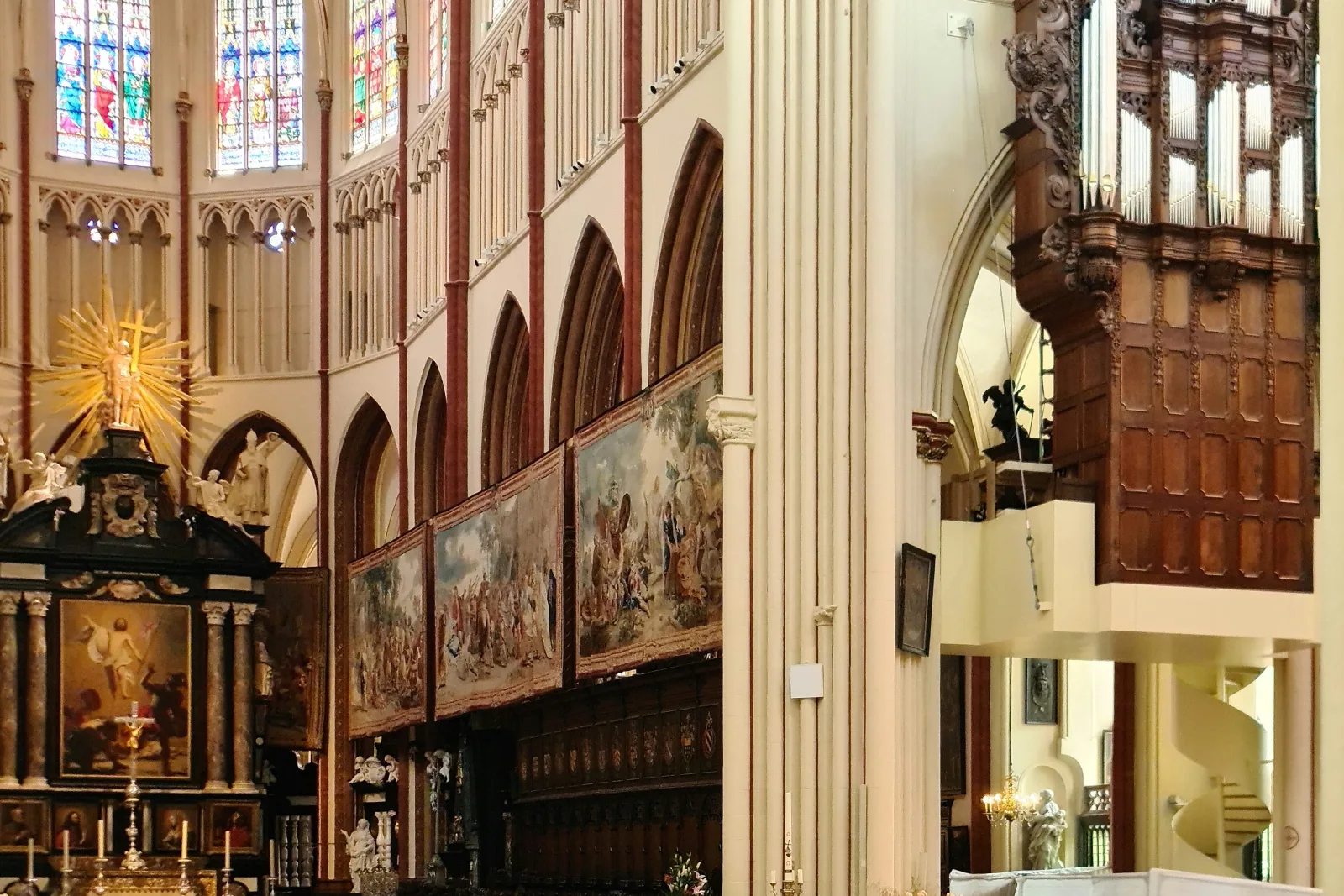
Eight tapestries of the life of Christ hang in the choir, above the stalls. They were woven around 1730 in the Brussels workshop of Jasper Van der Borcht, in wool and silk, and six of them are about seven metres wide. Bishop Hendrik-Jozef van Susteren ordered them for St Donatian's: there the painted designs hung in the choir all year, and the tapestries were hung in front of them only on high feast days. His arms are woven at the top of each border and his motto, "Ut prosim" ("that I may be of use"), at the bottom.
The painted designs, by Jan van Orley or his brother Richard, are in the cathedral too. Compare one with its tapestry: the weaving technique makes every scene come out as a mirror image of the painting. The scenes run from the Adoration of the Shepherds to the Resurrection.
Bruges had its own weavers as well: tapestries were made in the city from about 1500 into the 17th century. The Gruuthuse Museum shows Flemish tapestries of the 16th and 17th centuries.
The Golden Fleece above the choir stalls
The oak choir stalls date from around 1430. Above them hang the painted coats of arms of the Knights of the Golden Fleece, put up for the Order's chapter held here in 1478, a year after Charles the Bold was killed at Nancy. At that chapter Maximilian of Austria, husband of Charles's daughter Mary of Burgundy, was made head of the Order. Look for the word "trespassé" on a ribbon: it marks the knights who had already died.
Charles the Bold is the Karel de Stoute our hotel is named after. Our Charles the Bold guide tells his story.
Other works to look for
The rood screen at the west end, in white and black marble (1679 to 1682), crowned by God the Father by Artus Quellinus the Younger.
The two organs: the Van Eynde organ of 1717 to 1719, restored to its original state, and the Klais organ on the rood screen. Both were inaugurated in June 2023.
The tomb of Jean Carondelet (1549), one of the finest Renaissance sculptures in Bruges, brought from St Donatian's.
The shrine of Charles the Good (1883 to 1885), the count of Flanders murdered in St Donatian's in 1127. Not to be confused with Charles the Bold.
The treasury
The treasury is a small museum in the chapter wing, open since 2002. Its best piece is the Martyrdom of St Hippolytus, a triptych begun by Dirk Bouts around 1470 and finished after his death by Hugo van der Goes. There are also works by Pieter Pourbus, brass tomb slabs, ivories, manuscripts and goldsmiths' work. Its hours are a little shorter than the church's (below).
The churches and towers of Bruges
Three towers set the skyline of Bruges:
The Church of Our Lady: about 115 metres, the highest building in the city. Our Church of Our Lady guide has more.
The Belfry: 83 metres. It lost its wooden spire to a fire in 1741, when it was about 102 metres high.
St Salvator's: almost 80 metres, with its 19th-century crown.
Bruges has a dozen more churches and chapels worth a look, from St James's, the parish church of the Burgundian dukes, to the Jerusalem Chapel with its oriental tower. Our guide to the churches and towers of Bruges tells you which tower is which, what to see inside each, and when they are open.
Opening hours
Monday to Friday
10:00 to 13:00 and 14:00 to 17:30.
Saturday
10:00 to 13:00 and 14:00 to 15:30.
Sunday
14:00 to 17:00.
Masses
the cathedral is closed to visitors during services. Mass is at 18:00 on weekdays, 16:00 on Saturday and 10:00 on Sunday.
Holidays
on 1 January, Ascension Day, 24 December and 25 December the church opens only in the morning (10:00 to 13:00); on Easter Sunday, Whit Sunday, 1 November and 15 November only in the afternoon (14:00 to 17:00).
The treasury's hours
Monday to Friday
10:00 to 12:30 and 14:00 to 17:00.
Saturday
10:00 to 12:30.
Sunday
14:00 to 17:00.
Closed
1 January, Ascension Day, 24 December and 25 December.
Access and practical
Entry
the cathedral is free.
Access
Visit Bruges lists the paths as accessible without help; pushchairs are welcome.
The tower
it cannot be climbed. For the view, climb the Belfry.
How long do you need?
As a guide: 30 to 45 minutes for the church, and about as long again for the treasury.
Getting there from Hotel Karel de Stoute
The cathedral is about 10 minutes on foot from our door on Moerstraat, through the shopping streets towards 't Zand. It fits well between the Markt and the Church of Our Lady.
Frequently asked questions
Is St Salvator's Cathedral free?
Yes, entry to the cathedral is free.
When is St Salvator's Cathedral open?
Monday to Friday 10:00 to 13:00 and 14:00 to 17:30, Saturday 10:00 to 13:00 and 14:00 to 15:30, Sunday 14:00 to 17:00. It closes during Mass.
Is St Salvator's the oldest church in Bruges?
It is called the oldest parish church in Bruges: a church here is first mentioned in 988. The oldest part still standing is the base of the tower, from the 12th century.
Why is the cathedral not the Church of Our Lady?
St Salvator's became the cathedral in 1834, when the bishopric was restored. The old cathedral, St Donatian's on the Burg, had been pulled down in 1799.
How tall is the tower of St Salvator's?
Almost 80 metres, according to the cathedral. The Church of Our Lady is higher, at about 115 metres.
Which churches should you see in Bruges?
Start with the three with their own guide: St Salvator's Cathedral, the Church of Our Lady with Michelangelo's Madonna, and the Basilica of the Holy Blood on the Burg. For the other churches and which tower is which, see our churches of Bruges guide.
More guides
All guides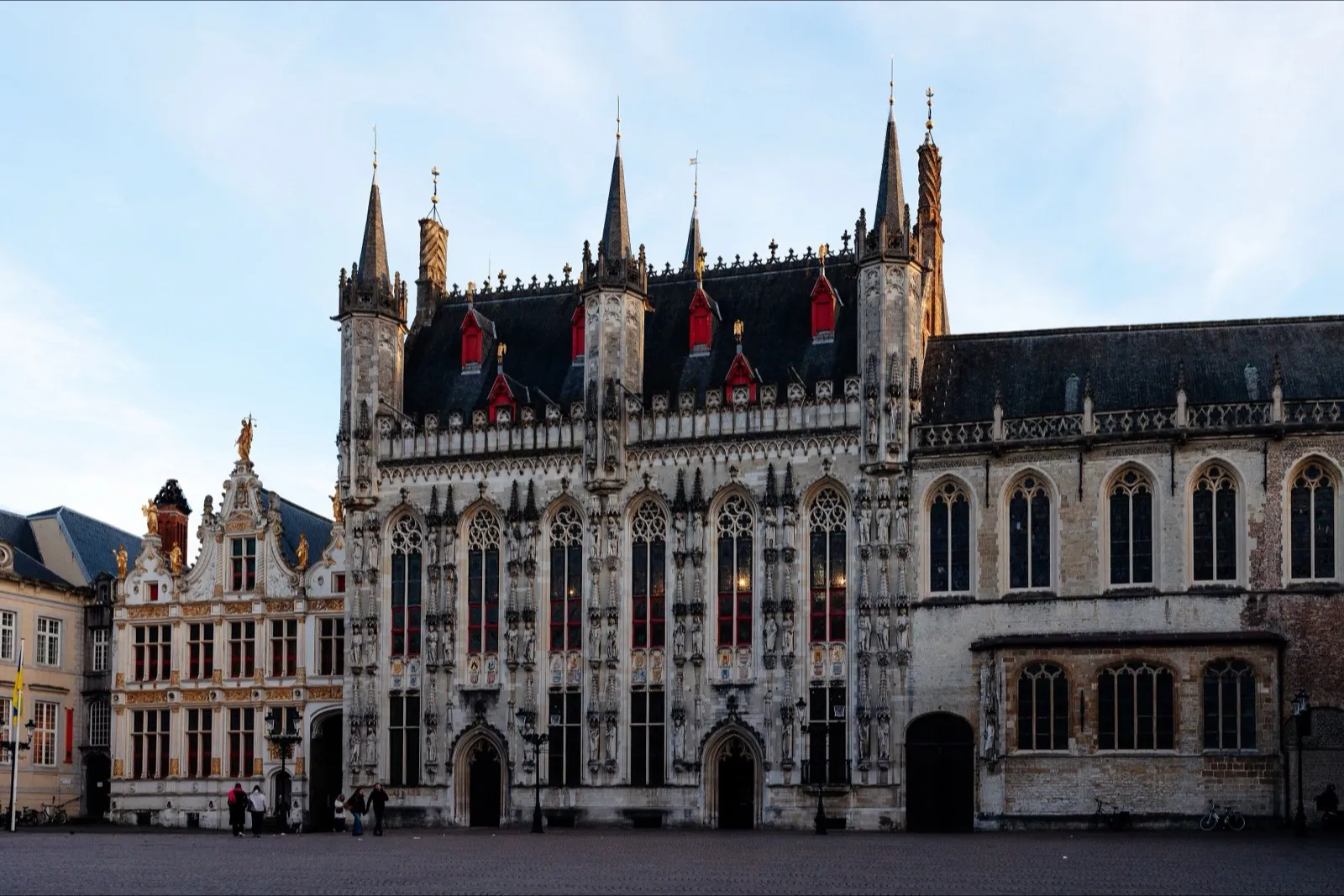
Sights
The Burg: Town Hall and Holy Blood
The Gothic Hall, the free basilica and when the relic is shown.
Read the guide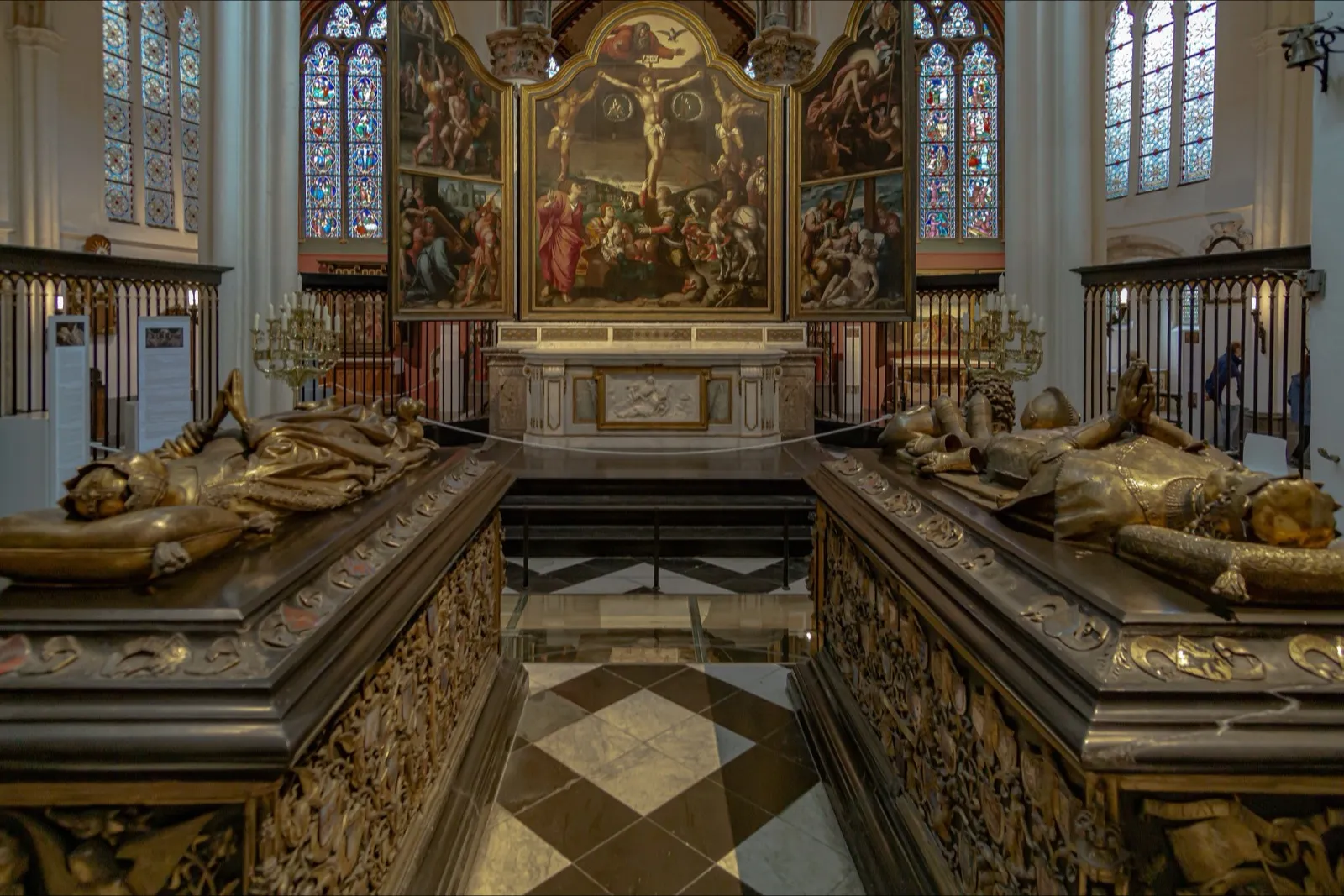
Burgundian history
Charles the Bold and Burgundian Bruges
The duke our house was built for, his wedding of 1468 and where to see his traces.
Read the guide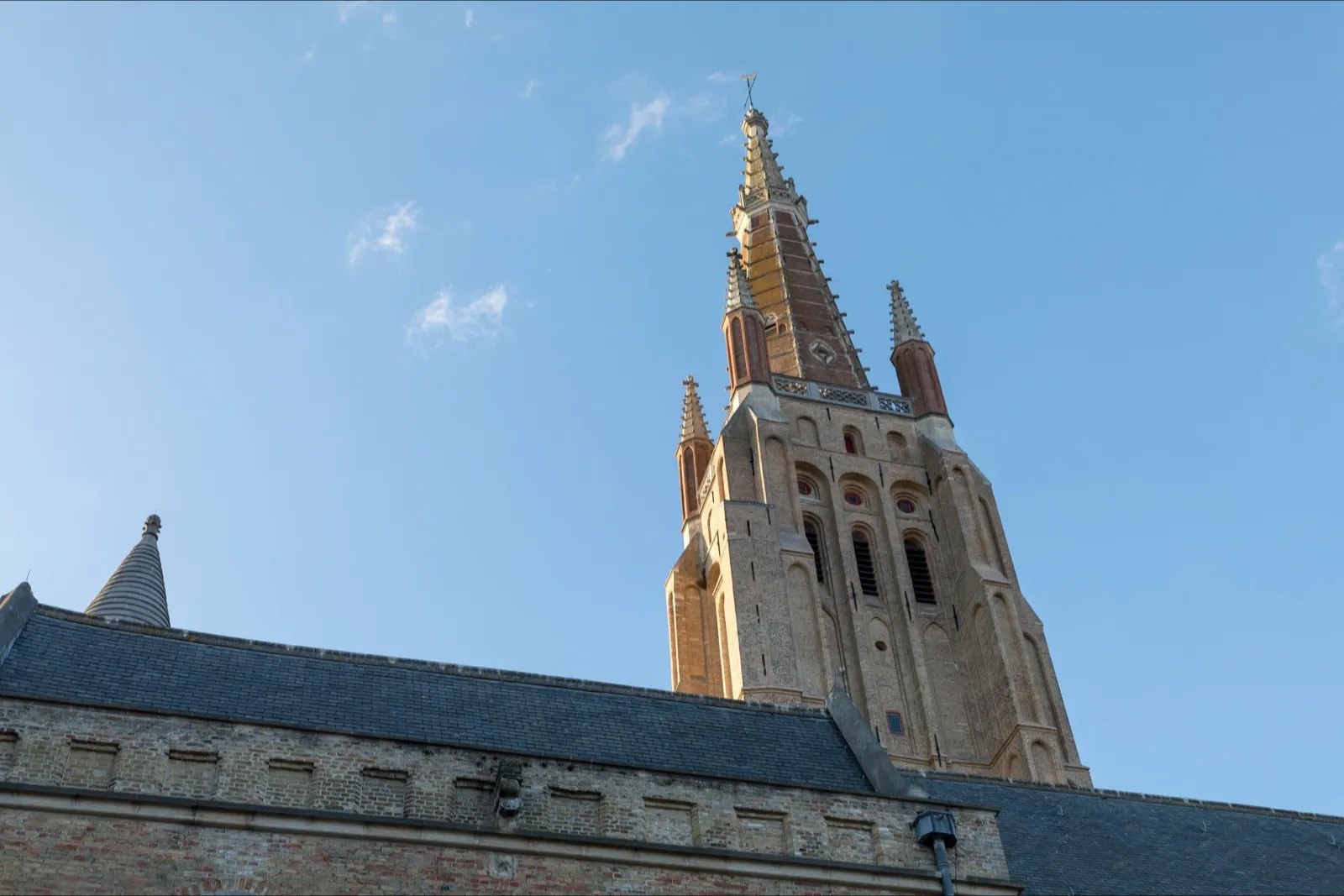
Sights
Church of Our Lady and Michelangelo
Michelangelo's Madonna and the tombs of Mary of Burgundy and Charles the Bold.
Read the guide
Stay in a house built for Charles the Bold
Moerstraat 23, five minutes from the Markt. Book here for €10 less than on Booking.com.
Check Availability